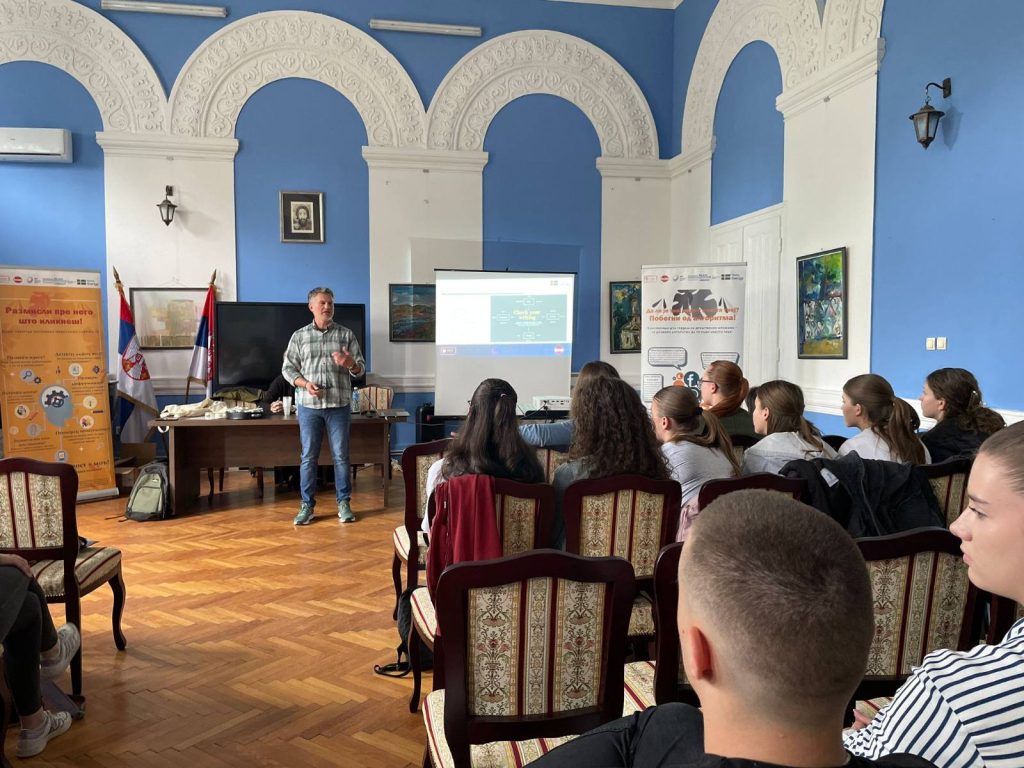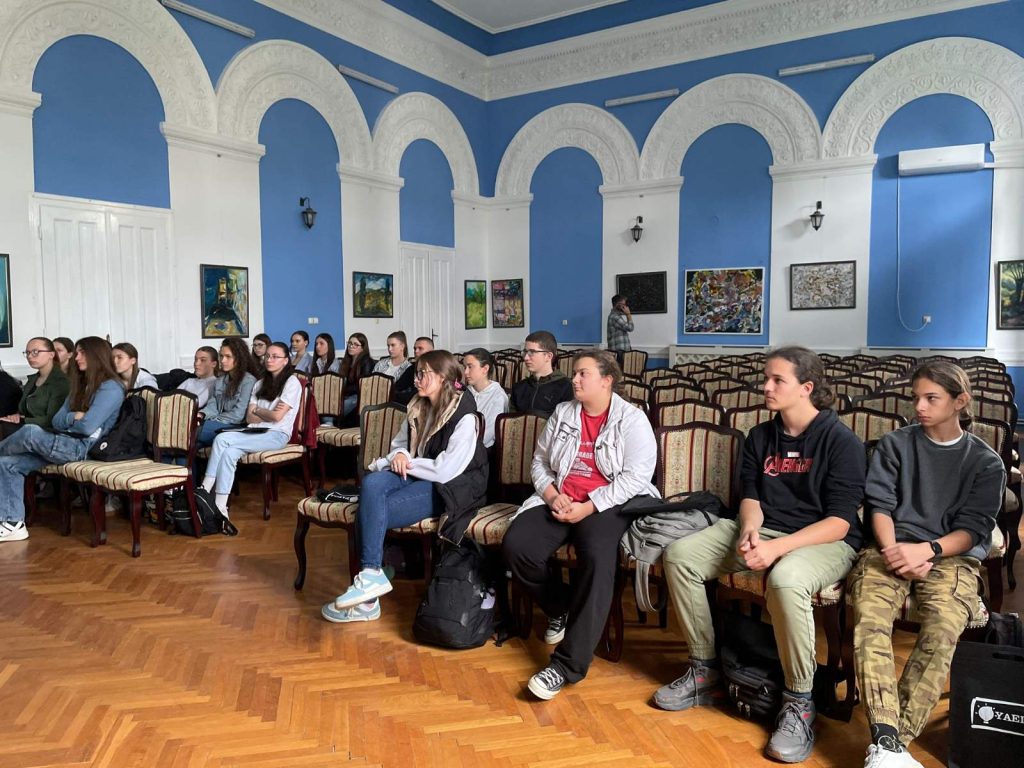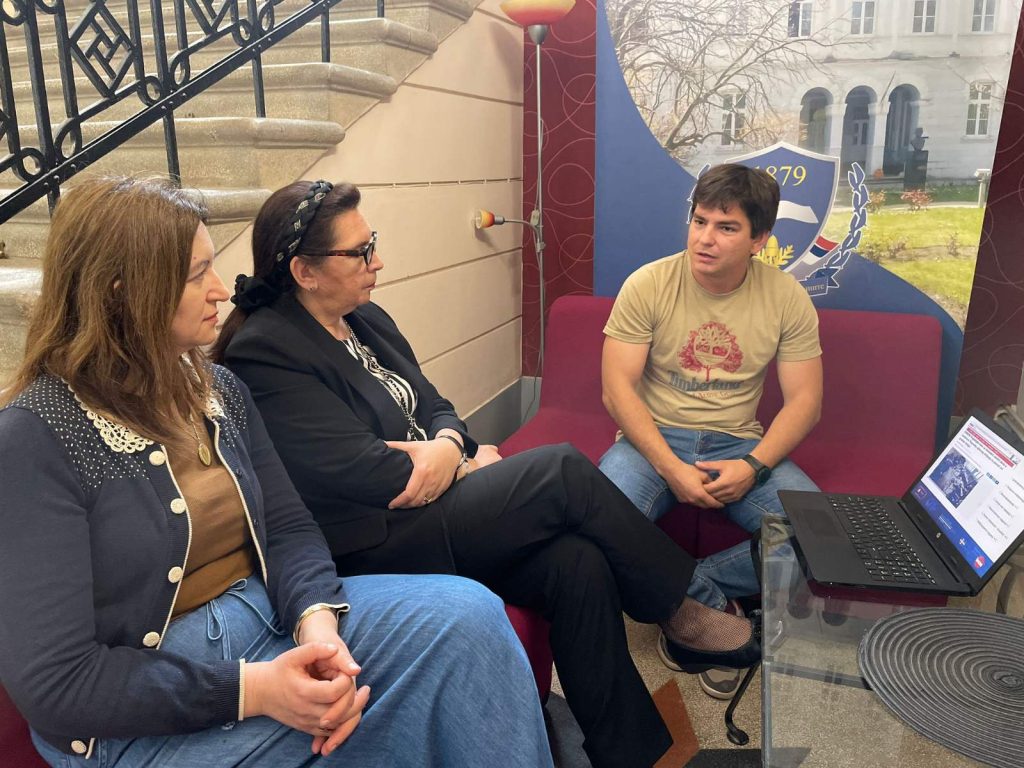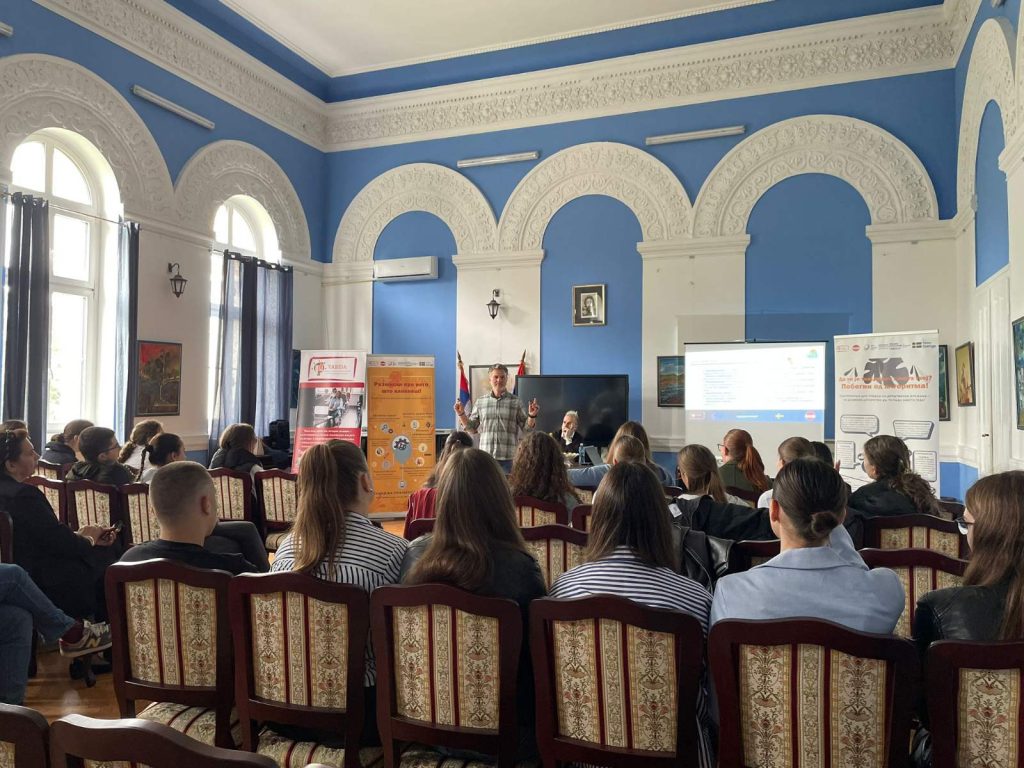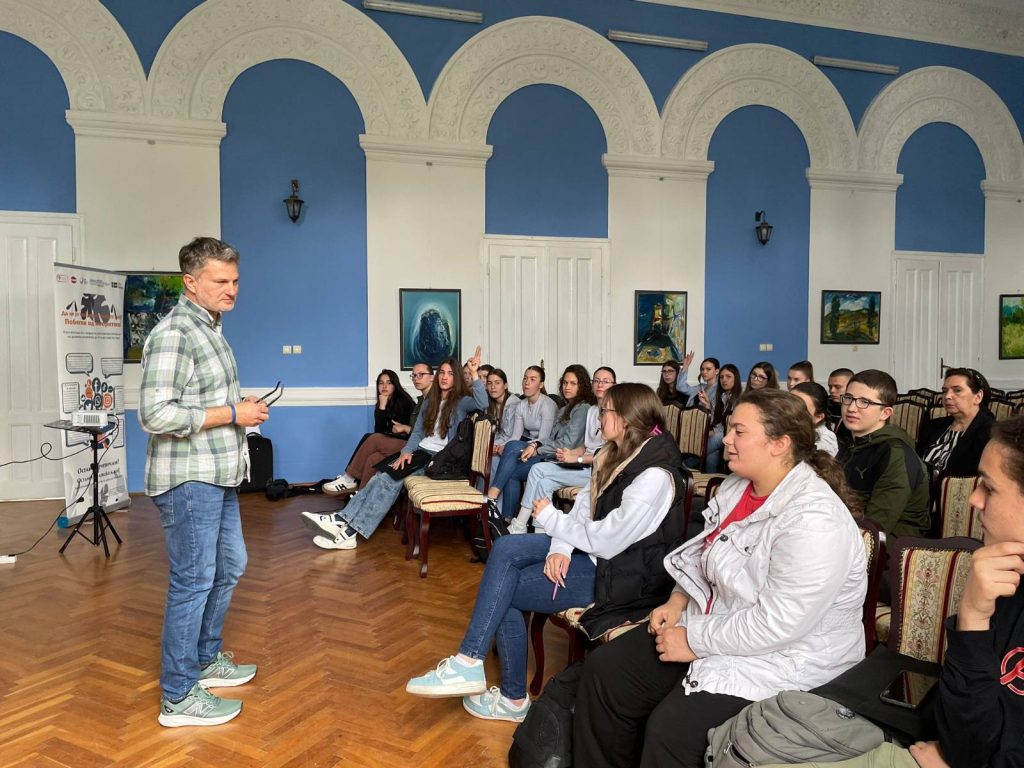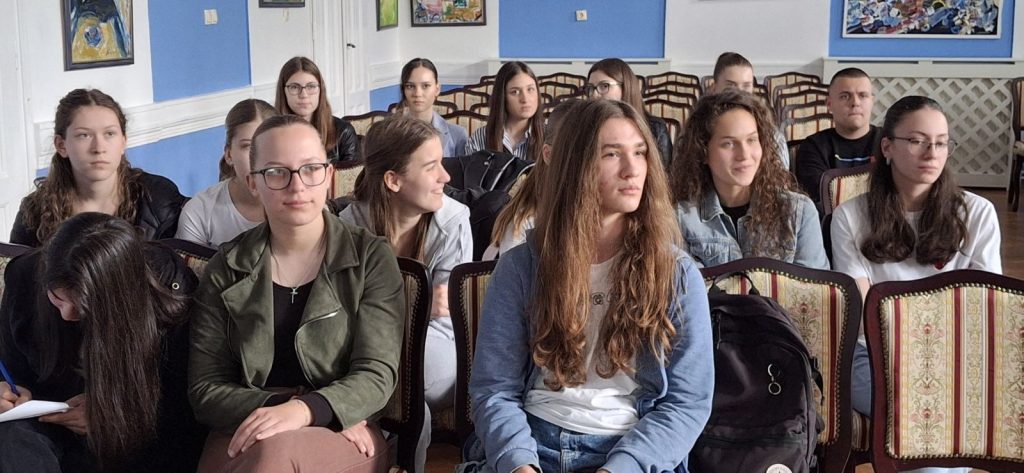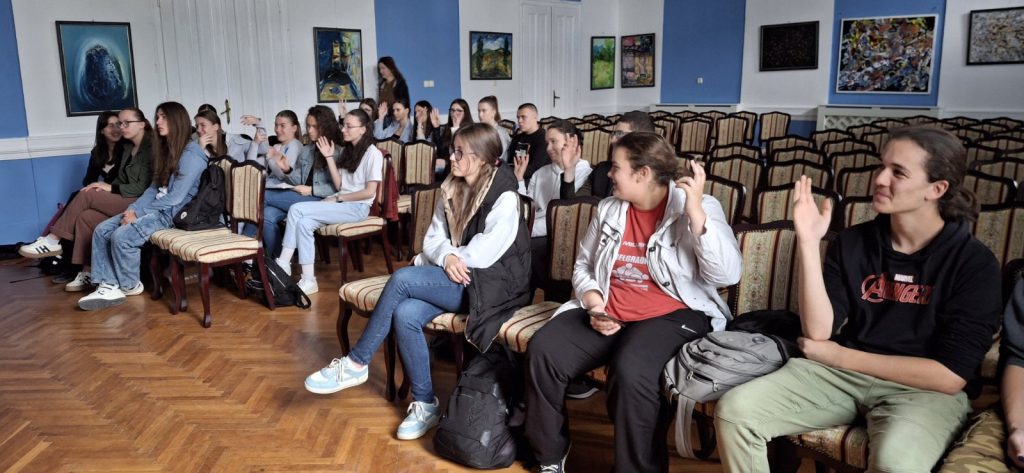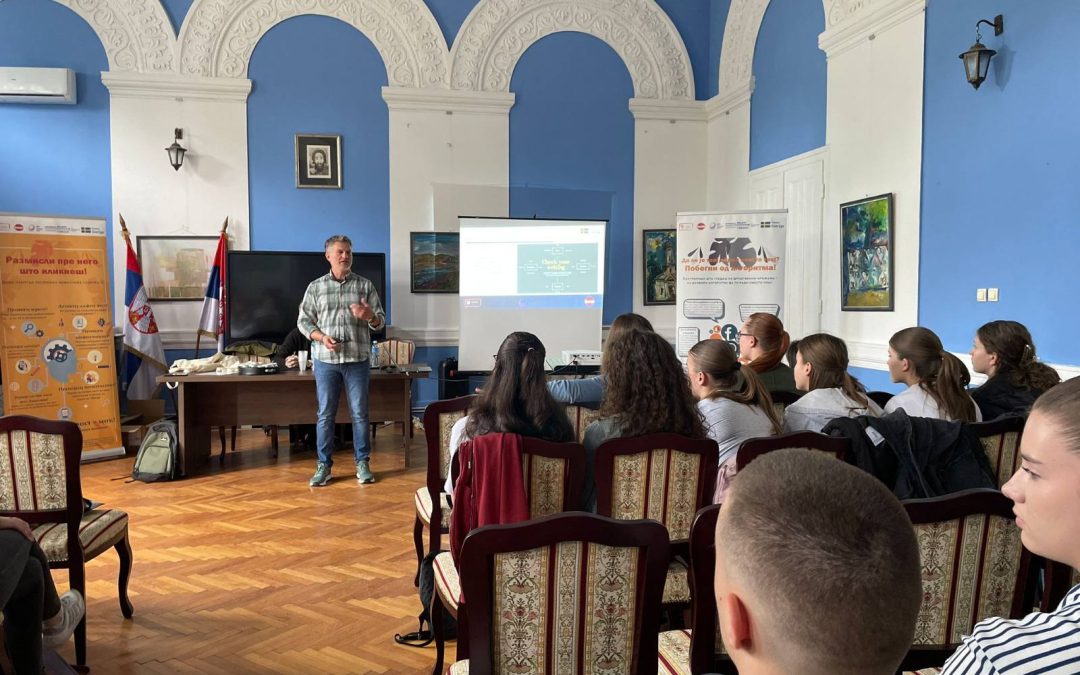
On Thursday, May 8, a media literacy workshop was held as part of the “Lie Detector” project at the “Miloje Vasić” High School in Veliki Gradište. The workshop was attended by students of the 1st, 2nd and 3rd grades of this school. First, at a workshop led by Marko Tadić, an expert in social networks, they learned about the way social networks attract the attention of their users. Also, they established knowledge about what algorithms are and how they work. Photo: J. Milenković/Boom93 When it comes to the social networks themselves, the students we talked to told us that they use Instagram and TikTok the most, and the content they consume definitely depends on their interests – from political topics, to makeup and food, to sports. With Serbian language teacher Slobodan Jotić, we renewed basic knowledge about media literacy and terms such as disinformation, media manipulation, misinformation, etc. Through the discussion of concrete examples, they were introduced to the basic techniques for recognizing fake news. At the same time, history teacher Živojin Ivković held a training for teachers, which was attended by two female professors of this school. They were presented with material that can be used when dealing with topics related to media literacy, as some of the possible models for approaching these topics in class. We asked female professors if they had any kind of methodical approach to media literacy during their studies. “Considering that we are dealing with social sciences, we certainly passed. However, at the time when we were studying, it was a little different. There were no social networks then. There was no such type of information as there is today,” said philosophy professor Jasmina Glišić. She points out that today’s children are more informed. “Information is more accessible to them, but they are also more susceptible to various manipulations, that is, the possibility of receiving incorrect information and being led astray,” said Glišić. She added that this time is also a challenge for professors. “We have to adapt every day, to find out, to position ourselves in a critical way, even as skeptics towards everything that is presented to us in order to guide the students who observe information from their point of view and everything that is presented to them in a different way. I think that experience is on our side, and also the basis of media literacy that we adopted during our studies”, states Glišić. The introduction of media literacy, perhaps even as a separate subject, to the study programs of the faculties where future teachers are trained, according to art history professor Sanja Stefanović, is very important. “Study programs must follow the course of time and be in line with what is happening in society, everywhere in the world. This is very important both for the sake of the teachers themselves and for the sake of the students they will teach. Media literacy is one of the important branches of understanding society and the world we live in,” said Professor Stefanović. After the theoretical part, there followed the practical application of knowledge through the game. Namely, the students had the task of telling one seemingly unbelievable but true piece of information about themselves, as well as one untrue one by expressing it in a sensationalist way. The other students analyzed what was correct and what was incorrect information. After the workshop, we talked with the students and professors about their impressions from the workshop and about their media habits.